

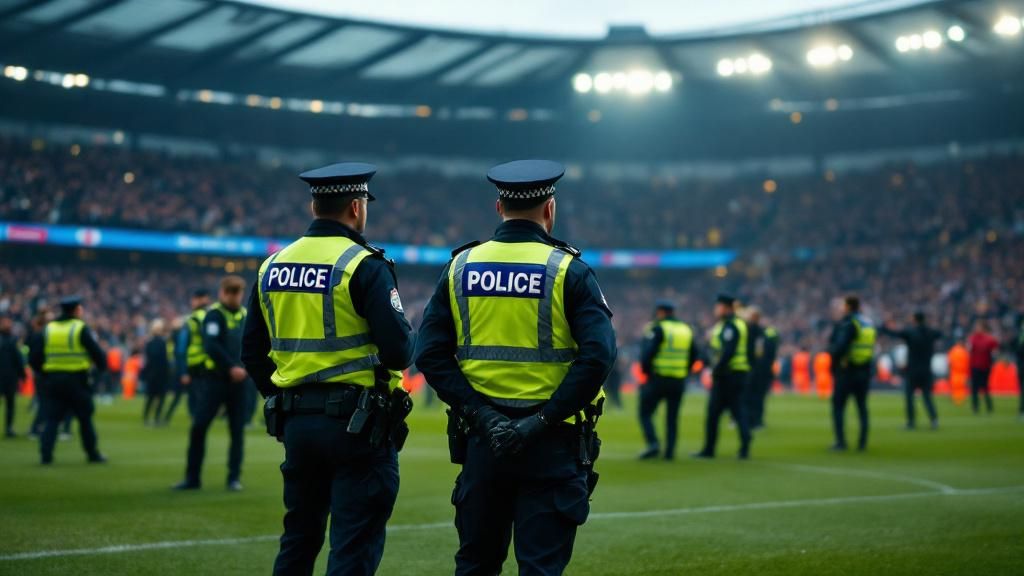
Violence broke out at Ibrox Stadium on Saturday after Celtic supporters invaded the pitch following their 3-2 win on penalties over Rangers in a Scottish Cup quarter-final tie. The disturbing incidents unfolded after 120 minutes of subpar play, as approximately 7,500 Celtic fans poured onto the playing surface at the Broomloan Road end. The pitch invasion triggered a fierce response from Rangers supporters in the Copland Stand, who flooded the pitch in large numbers, some wearing masks. The confrontation resulted in scuffles involving Celtic staff and players, including an incident with full-back Julian Araujo, while missiles and a flare were thrown between rival supporters. Police and stewards moved to divide the fans and regain control at the Glasgow venue.
A Match Characterized by Mediocrity and Missed Chances
The 120 minutes prior to the pitch invasion were characterized by an striking dearth of quality from both sides. Celtic’s journey to the Scottish Cup semi-finals was built on the most unstable foundation — they managed just one shot on goal throughout the full match and failed to register a single strike that threatened the goalkeeper. Notwithstanding their own notable deficiencies and defensive vulnerabilities, Celtic somehow survived the ordeal, ultimately prevailing in the shootout when Tomas Cvancara defeated Jack Butland. Rangers, in contrast, were branded as “an abomination,” failing to take advantage on Celtic’s frailties or impose their own authority on proceedings.
The match was marked by an endless catalogue of football’s most glaring flaws: poor passing, crosses sailing wide, wasted free-kicks, constant lack of accuracy, and an overwhelming reliance on long-ball tactics and aerial play rather than organized attacking. Both teams were unable to build any steady pattern or clear ability, with disciplinary issues increasing and tactical discipline evaporating. The quality of football on display was so dire that it seemed entirely appropriate that such an underwhelming contest would end in the turmoil and unsavory nature of the aftermath rather than any display of true athletic merit.
- Blocks, wayward distribution, and crosses flying out of play dominated proceedings
- Free-kicks wasted and aerial contests disrupted organized, disciplined football play
- Celtic’s sole shot on goal came with no shots on target
- Rangers couldn’t take advantage given Celtic’s defensive vulnerabilities throughout match
The Penalty Incident and the Turning Point
After 120 minutes of exhausting, error-strewn football, the match inexorably progressed to a shootout from the spot. Both teams had squandered chances during the match, and neither had clearly shown they deserved to advance. The tension mounted as each side came forward to convert from the spot, with Jack Butland protecting Rangers and the semi-finals. The Rangers keeper had been mostly unimpactful across the game, and as the penalties progressed, his failure to deliver a crucial save became increasingly apparent. Celtic’s squad members stepped up to the line with a blend of determination and urgency, knowing that one finished attempt could spark wild celebrations.
The pivotal moment came when Tomas Cvancara prepared to take his penalty. With the tension rising and both teams having successfully made their previous attempts, Cvancara’s shot struck the goal, getting past Butland and propelling Celtic through to the Scottish Cup semi-finals. It was a moment that should have been one of pure celebration and relief — the conclusion of a closely contested, if thoroughly dull, contest. Instead, this moment of competitive success proved to be the prelude to something considerably darker, as Celtic supporters’ jubilation would quickly transform into scenes of disorder and violence that would diminish any sense of achievement.
The Game-Winning Basket That Triggered Chaos
Cvancara’s successful penalty was the official end of the match, but it served as the catalyst for the chaos that followed. As the ball hit the net, Celtic’s traveling support — approximately 7,500 strong at the Broomloan Road end — erupted in celebration. However, their excitement quickly resulted in a choice that would become disastrous: a crowd surge onto the pitch. Supporters poured onto the field, dancing, waving, and celebrating their team’s progression. What could have appeared like innocent enthusiasm constituted a serious violation of stadium protocol and a dangerous escalation that authorities had sought to avoid through modern safety measures and crowd control procedures.
The pitch invasion immediately changed the atmosphere at Ibrox from one of sporting disappointment to one of genuine menace. The Rangers supporters in the Copland Stand watched as their rivals rejoiced on the turf, and what began as a modest number of Rangers fans threatening to respond swiftly spiraled into something substantially more grave. The presence of large numbers of Celtic supporters on the pitch, combined with the inflammatory nature of their celebration, created a tinderbox scenario. The Rangers dam, as one observer noted, burst completely, with large numbers of domestic fans responding to what they perceived as a hostile intrusion into their territory, setting the stage for the brutal clashes that would follow.
Turmoil Develops as Supporters Flood across the Pitch
What commenced as a pitch invasion celebration quickly escalated into scenes of violence and chaos that would characterize the immediate aftermath of the Old Firm Cup tie. As supporters of Celtic flooded onto the playing surface, Rangers fans initially held back, but the sight of rival supporters dancing joyfully on their home ground proved too much to bear. The Rangers fans in the Copland Stand, witnessing what they considered to be an provocation, began pouring onto the pitch in increasingly large numbers. Many donned masks, their faces covered as they advanced with apparent purpose toward Celtic staff and players. The stewards and police, despite their best efforts to keep order, found themselves overwhelmed by the enormous scale and speed of the invasion, unable to stop the perilous convergence of opposing supporters that was now unfolding.
The scenes at Ibrox represented a worrying reversion to pre-2018 norms of spectator behavior, when such pitch invasions and following altercations were more prevalent. The decision to extend the number of visiting fans to 7,500 had been decided with honest intent, grounded in expectations regarding modern fan conduct and improved safety protocols. Yet the occurrences during that match laid bare the weakness of those beliefs and raised serious questions about ground protection and crowd management strategies. As projectiles started sailing across the pitch — such as a flare launched from Rangers fans toward the Celtic end — it became clear that the situation had spiraled beyond the management of officials, with the real possibility of a serious altercation between opposing supporters becoming increasingly imminent.
- Rangers supporters poured onto the pitch in substantial, aggressive numbers from the Copland Stand
- Many Rangers fans donned face coverings, concealing their identities as they headed toward Celtic personnel
- Celtic staff worked to stop incidents and guide players away from high-risk areas
- Missiles such as flares were launched between competing fan sections across the pitch
- Police and stewards struggled to contain the disorder and separate the rival groups
Confrontations and Growing Tensions
The most troubling moment came when a Rangers supporter confronted a member of the Celtic backroom staff, leading to a physical altercation that left observers seriously worried. Celtic manager Martin O’Neill later explained that his staff member had been attempting to prevent an incident from escalating when he was forced down by stewards and police. The exact nature and severity of the contact was unclear, but the image of a visiting coach being forcibly restrained by security personnel in such circumstances was shocking and deeply worrying. Shortly after this incident, another Rangers fan or group of fans engaged with Julian Araujo, the Celtic full-back, in what appeared to be another attempt at direct confrontation the visiting team.
O’Neill’s reaction to Araujo’s participation in the confrontation — leading the player away with visible concern evident across his face — underscored the genuine danger that the situation had reached. For a brief, frightening moment, it seemed possible that the rival fan groups would make direct contact with one another, potentially resulting in widespread violence across the pitch. Mercifully, this worst-case outcome was prevented, though only through the determined efforts of police and stewards who succeeded in maintaining a physical barrier between the two groups. The incident served as a stark reminder of the dangers involved in allowing significant numbers of away supporters into hostile settings, especially when emotions are elevated following an emotionally intense contest.
Inquiries About Safety Protocols and Away Supporter Seating
The post-match violence at Ibrox has raised fresh concerns about the wisdom of increasing away fan allocations at Old Firm derbies. With 7,500 Celtic supporters present, the match represented a return to pre-2018 attendance levels for visiting fans — a policy decision that now appears increasingly questionable in light of the day’s events. Observers have queried whether raising these numbers was advisable, particularly given the underlying friction that characterize fixtures between Rangers and Celtic. The obvious dangers posed by such large visiting contingents in a unwelcoming atmosphere, combined with what some view as misplaced faith in supporter conduct, have proven undeniable following the scenes that unfolded at the Broomloan Road end.
The reasoning behind allowing larger away allocations seems deeply problematic when weighed against the security risks demonstrated on match day. Police and stewards were operating at maximum stretch attempting to manage the chaos, and it took considerable effort to prevent opposing fan bases from engaging in physical confrontations. The incident raises uncomfortable questions about whether Scottish football authorities have properly assessed the implications of their allocation decisions, and whether the push to welcome increased numbers of away supporters has been placed over genuine safety concerns. Stakeholders must now grapple with whether this policy constitutes an tolerable level of risk or whether enhanced security measures must be reintroduced.
| Concern | Impact |
|---|---|
| Increased away fan numbers creating hostile environment | Greater likelihood of confrontations and pitch invasions |
| Inadequate police and steward resources | Difficulty containing violence and separating rival groups |
| Masked supporters obscuring identities | Reduced accountability and emboldened aggressive behavior |
Scottish football authorities face mounting pressure to reassess their approach to away fan quotas at Old Firm matches. The incidents of March 8th have demonstrated that the current system might be severely compromised, with safety protocols failing to handle substantial away support in such a volatile atmosphere. A detailed examination of security measures, quota levels, and implementation procedures seems critically important to prevent similar incidents from happening in upcoming matches.
What Lies Ahead for Scottish Football
The unrest that marred Celtic’s penalty victory has thrust Scottish football into a moment of reckoning. Football officials and club officials must now confront challenging calls about how these matches are administered going forward. The Ibrox incident has revealed fundamental weaknesses in present security procedures, pressuring stakeholders to balance the revenue gains of increased away allocations versus the very real dangers demonstrated on game day. Whether authorities respond with meaningful reform or stick with the status quo will shape the sport’s dedication to supporter safety.
Celtic boss Martin O’Neill’s measured response—recognizing the staff member’s attempt to prevent further incident—offers a hint of insight in the midst of turmoil. However, his words cannot obscure the troubling reality that pitch invasions have returned to Scottish football after years of comparative peace. The existence of masked fans, the hurling of missiles, and the near-confrontation between rival fan groups all point to a match demanding urgent intervention. Without prompt measures, the risk of escalated violence at future Old Firm encounters stays worryingly elevated.
- Consider and possibly cut away fan allocations at hostile venues
- Enhance police and steward training for managing large crowd situations
- Establish stricter identity verification and face covering requirements
- Set clearer consequences for pitch invasions and fan misbehavior
